How to Choose a Sofa: Size, Shape, and Style That Actually Fit
Choosing a sofa is the highest-stakes furniture decision in any room. Learn how to get size, shape, and style right — and preview it before you buy.
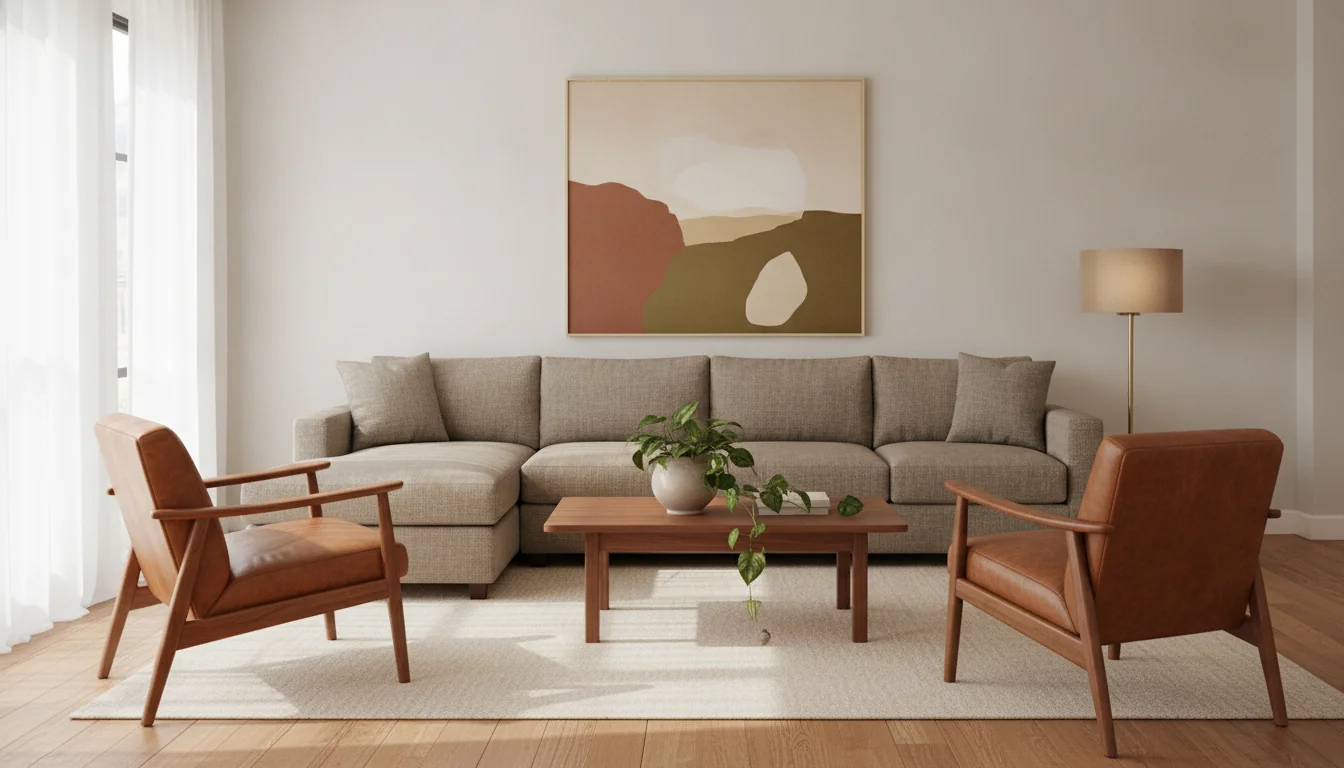
A sofa is the single most-regretted furniture purchase in any home. Not because people pick the wrong color — color is easy to fix with a throw blanket — but because they pick the wrong size, the wrong shape, or the wrong depth for the way they actually live. The sofa arrives, the delivery crew leaves, and within a week you realize it’s either too big for the room (it crowds the coffee table), too small for the room (it looks like a waiting-room loveseat), or the wrong height for how your family actually sits on it. And unlike a lamp or a side table, a sofa is heavy, expensive, and miserable to return.
Choosing a sofa is a sequence of decisions — scale, shape, seating depth, fabric, and style — that most people make in the wrong order. They pick a color first, then a shape, then hope it fits. The right order is the reverse: measure the room and the doorways first, decide the shape and seat depth second, match the fabric to your household third, and choose the style and color last. That order is hard to follow when you’re shopping online, because every sofa listing leads with the photo and buries the dimensions on the third tab. This guide walks the sequence step by step, and shows how modern AI room preview tools close the gap between the sofa you’re considering and the reality of seeing it in your actual room before the order ships.
What is a sofa buying guide? This is not a style guide. This is a decision framework that covers measuring technique, shape selection, seating-depth ergonomics, fabric durability by household profile, and the AI preview workflow that lets you see any sofa in your actual room before you commit. The goal is one sofa, one delivery, one room that works — instead of the two-or-three-sofa shuffle that millions of households repeat every year.
Why the sofa is the highest-stakes purchase in a room
No other piece of furniture carries the combination of cost, size, daily use, and sheer difficulty-of-undo that a sofa does. A dining table can be moved to another room if it doesn’t work. A rug can be returned rolled up in a box. A sofa arrives in a truck, requires two people to move, and once it’s in the room, the room is organized around it. Getting it wrong means living with the mistake or paying return shipping — typically $100 to $300 — to send it back.
Three factors make the sofa uniquely high-stakes:
Scale dominance. A sofa occupies 20 to 50 square feet of floor space — more than any other piece in the room except maybe a sectional. Its size determines the room’s circulation. A sofa two inches too wide can block a traffic path. A sofa six inches too deep can push the coffee table into the TV sightline. These are problems you cannot fix with a different throw pillow.
Daily-use fatigue. The sofa is the piece you sit on more than any other furniture. It’s the surface where your body makes contact for the most daily hours. A sofa with the wrong seat depth — too shallow for your height — creates discomfort you feel every single evening. That’s not a design problem; it’s an ergonomics problem dressed up as a furniture decision.
The return asymmetry. Sofa return rates in the US furniture industry hover around 15 to 20 percent, and the cost of returning a sofa often exceeds the emotional cost of keeping one you don’t love. Consumers keep wrong sofas more often than they return them, which means the wrong decision is sticky.
The single most effective tool for reducing sofa regret is previewing the sofa in your actual room before the purchase. The same principle that drives how we recommend previewing before you renovate applies here: you need to see the piece at your scale, in your lighting, against your wall color, with your existing furniture, before you can judge whether it fits. And the tool that makes that possible — AI room preview — is now fast enough to use at sofa-shopping speed.
Measuring for a sofa (and the doorway test)
Measure the room before you measure the sofa. Most sofa measurement guides start with the sofa dimensions and work backward to the room. That is backwards. You need to know the room’s constraints first — specifically, the maximum sofa width the room circulation can tolerate — and then search for sofas that fit inside that constraint.
Step one: measure the wall. Measure the wall you plan to put the sofa against. Subtract 12 to 18 inches from that wall length for clearance on each side. The sofa should not touch either wall; it should have breathing room. A common mistake: buying a sofa that is exactly as wide as the wall, which makes the room look like a fitted sheet and leaves no room for a floor lamp or a side table. For a 12-foot wall, the maximum sofa width is roughly 9 to 10 feet.
Step two: measure the traffic path. Place a sofa so there is at least 36 inches of clear walking space between the front of the sofa and the opposite wall or coffee table. If the room is a narrow living room — say 12 feet wide — and the sofa is 40 inches deep, you need at least 36 inches in front of it, which leaves only about 68 inches for the sofa plus the TV stand behind it or the wall opposite. That’s tight. In narrow rooms, a shallower sofa makes the difference between a walkable room and a room you edge around sideways. Our how to measure a room for furniture guide covers the full clearance protocol room by room.
Step three: the doorway test. This is where most sofa purchases fail at the delivery stage. Measure every doorway, hallway turn, and stair landing on the path from the street to the room where the sofa will live. The critical dimensions are the width of the front door, the width of any interior door the sofa must pass through, the width of any hallway turn (90-degree corners are the worst), and the height from the floor to the top of the sofa clearance in its box or wrapped state.
| Recommended minimum | Tight pass (risky) | Impossible | |
|---|---|---|---|
| Front door width | 34 in | 30–33 in | Under 30 in |
| Interior door width | 32 in | 28–31 in | Under 28 in |
| Stair landing depth | 60 in | 48–59 in | Under 48 in |
| Turn clearance (90° corner) | 48 in | 40–47 in | Under 40 in |
If any of these are marginal, measure the sofa’s box dimensions, not the sofa’s assembled dimensions. Sofas arrive in a box or wrapped package that is often larger than the sofa itself, and that package has to clear every obstacle. Some delivery services offer a “measure before you buy” consultation; take it if it’s free, or use Roomagine’s preview tool to check the sofa scale in the room before ordering.
Step four: the layout test. Once the maximum sofa width is known, sketch or render the room with that sofa width in place. The AI preview that Roomagine generates — taking a photo of your actual room and rendering the sofa at scale in it — is the fastest way to confirm whether a 90-inch sofa looks right or whether an 84-inch would feel more balanced. The difference between the two is often invisible on paper and obvious in a render.
Shape: sectional vs sofa vs loveseat vs modular
The shape decision is about how the room is used, not how it looks. Each sofa shape serves a different seating pattern, and the shape that works for a household that hosts movie nights every weekend is different from the shape that works for a couple who reads in the living room.
| Shape | Best for | Seating capacity | Room orientation | Key constraint |
|---|---|---|---|---|
| Standard sofa (3-seat) | Daily TV, conversation, reading | 2–3 adults | One focal wall | Fixed orientation; cannot split or rearrange |
| Loveseat | Dens, reading nooks, small apartments | 1–2 adults | Tight footprints | Too small for main seating in a family room |
| Sectional (L-shape) | Movie nights, casual lounging, families | 3–5 adults | Corner or open-plan | Dominates floor space; hard to rearrange |
| Modular sectional | Frequent reconfigurations, multi-use rooms | 2–6 adults (configurable) | Open-plan, flexible layouts | Higher cost per seat; more seams and gaps |
| Settee / bench sofa | Entryways, dining banquettes, high-traffic | 2 (tight) | Against a wall or window | Not comfortable for extended sitting |
| Sleeper sofa | Guest rooms, studios, dual-use spaces | Sitting 2, sleeping 1–2 | Multi-purpose rooms | Uncomfortable seat depth; heavy mattress mechanism |
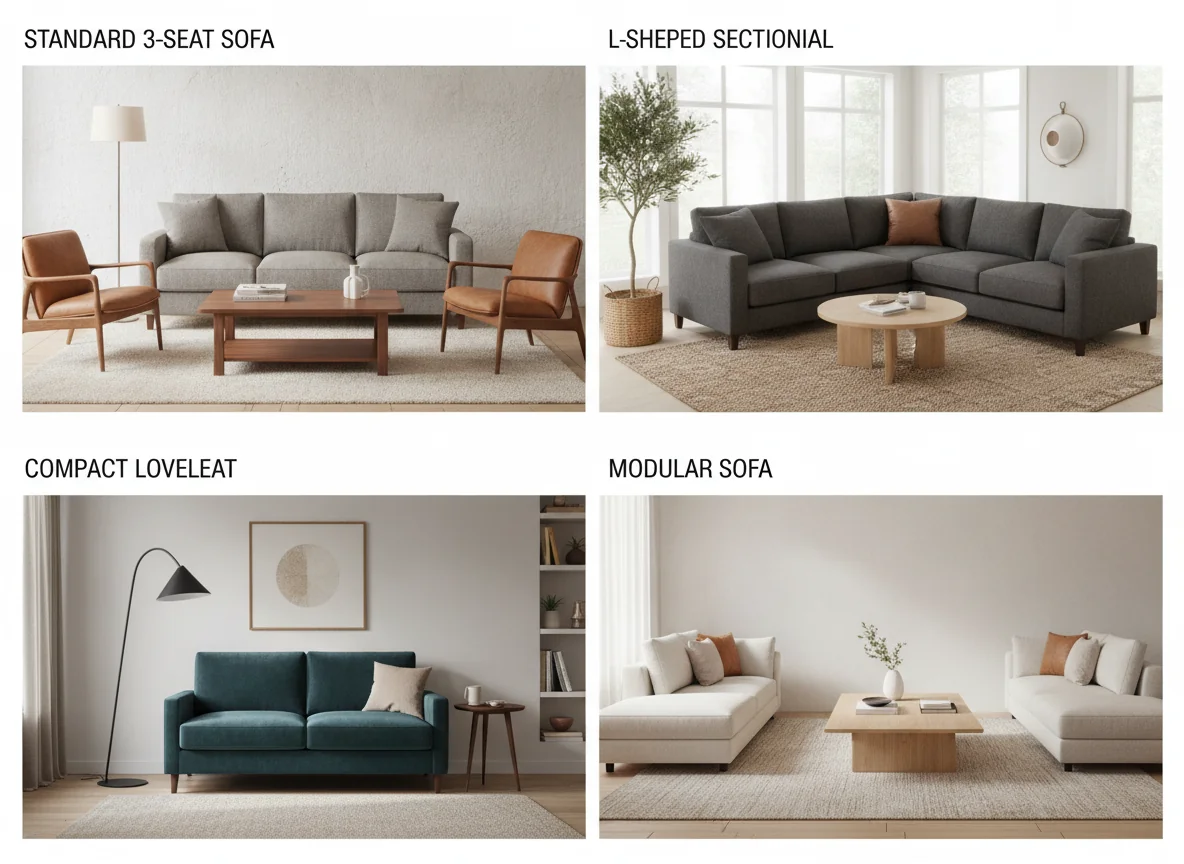
Standard sofa (three-seat). This is the safest choice for most living rooms. A roughly 78- to 90-inch sofa fits a standard 12- to 14-foot wall, seats three adults comfortably (two if the third is in the middle), and leaves enough floor space for a coffee table and two accent chairs. The limitation: it’s fixed. The sofa stays against the wall, and the room stays arranged around that one wall. If you want to face the sofa toward the fireplace in winter and toward the garden in summer, a standard sofa doesn’t flex.
Sectional (L-shape). The sectional is the right answer when the room has a corner you want to fill and the primary use is lounging rather than formal sitting. An L-shaped sectional in a 14-by-18-foot living room creates a conversational L that seats five without any other seating. The trade-off: the sectional determines the room’s layout completely. Once the sectional is in place, the coffee table position, the rug size, and the TV location are all decided by where the sectional sits. Moving a sectional in a room is a two-person, half-hour job at minimum. Our how to arrange living room furniture guide covers the layout logic for both sofa-first and sectional-first rooms.
Loveseat. A loveseat (48 to 60 inches) is not a primary sofa. It is a secondary piece that works in a den, a reading nook, a bedroom sitting area, or as part of a two-sofa arrangement opposite a main sofa. Treating a loveseat as the main seating in a living room results in guests sitting on the floor. Use it as an accent, not an anchor.
Modular sectional. Modular sofas are composed of individual seat units that can be arranged, detached, and reconfigured. They are the right answer for people who move frequently, for multipurpose rooms that shift use between seasons, or for rooms where the layout may change. They are more expensive per seat than a standard sofa of equivalent quality, and the seams between modules are visible. But the flexibility — a four-seat modular that works as an L-shape this year and a straight row next year — is unmatched for renters and frequent movers.
The shape decision simplifies dramatically when you render each option in your actual room. A sectional that looks like a natural fit in a Pinterest photo may dominate a render of your 12-by-14-foot living room; a standard sofa that seemed plain in the catalog may read as perfectly scaled when you see it against your actual wall.
Depth, seat height, and how you actually sit
The most overlooked specification on any sofa listing is the seat depth — the horizontal measurement from the front edge of the cushion to the backrest. Seat depth determines whether you sit upright, lounge, or somewhere in between, and most shoppers discover they own the wrong seat depth about a week after the sofa arrives.
| Seat depth | What it supports | Best for | Typical use |
|---|---|---|---|
| 20–22 in | Upright sitting with feet on the floor | Dining-adjacent seating; older adults; people with back concerns | Conversation, tea, short sits |
| 22–24 in | Standard sitting with comfortable recline | Average-height adults (5’6”–5’10”) | TV, reading, daily household use |
| 24–26 in | Lounging; feet up on coffee table | Taller adults; people who curl up | Movie nights, lounging, casual hosting |
| 26+ in | Deep lounging; requires extra pillows | Very deep sofas; oversize sectionals | “Sink into it” lazy-day sofas |
The seat depth you need depends on your height and how you sit. A 5-foot-2 person on a 26-inch-deep sofa sits with their feet dangling and their knees unsupported unless they curl sideways. A 6-foot-2 person on a 20-inch sofa sits with their knees bent at an acute angle and feels like they’re in a school chair. The golden range for the largest number of households is 22 to 24 inches — it accommodates both upright sitting and casual lounging for adults between 5-foot-4 and 6 feet.
Seat height (the distance from the floor to the top of the seat cushion) matters separately. Standard seat height is 17 to 19 inches, which matches the average adult’s knee height. Low seat height (15 to 17 inches) produces the “low-slung mid-century” look and is harder to stand up from — a problem for older adults and anyone with knee issues. High seat height (19 to 21 inches) is easier to stand from but may make the sofa read as casual or transitional rather than lounge-oriented.
| Seat height | Read | Ease of standing | Preferred by |
|---|---|---|---|
| 15–17 in | Low, lounge, mid-century | Difficult | Younger adults; design-forward households |
| 17–19 in | Standard, traditional | Normal | General population; majority of sofas |
| 19–21 in | High, easy-entry, transitional | Easy | Older adults; people with mobility needs |
Back height. Low-back sofas (under 30 inches) create a clean silhouette but provide no head or neck support. Mid-back (30 to 34 inches) is the most comfortable daily range. High-back (34+ inches) provides full support for taller people and creates a cozier, more enclosed seating feel at the cost of a heavier visual silhouette.
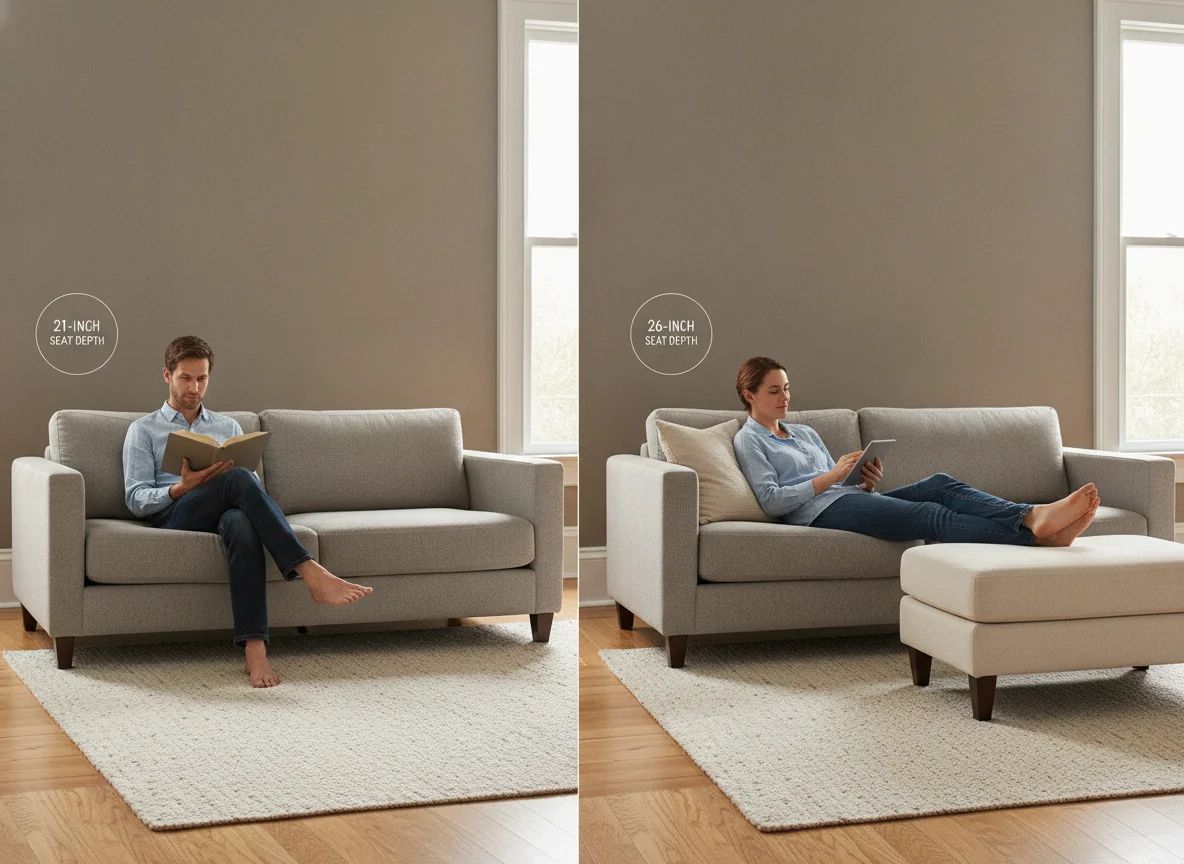
When you’re previewing a sofa in a render, specify the seat depth and seat height you’re considering. The AI render places the sofa in your room at scale, and the visual proportion — how much cushion shows relative to the coffee table, how high the back sits against the wall art — tells you whether the dimensions read as balanced in your specific space. For more on how scale decisions cascade through a room, our guide to furniture types and styles covers the broader coordination logic.
Fabric and durability by household type
The fabric is the layer most people choose first, and it should be chosen last — after the size, shape, and depth are locked. Fabric is not a style decision; it is a durability decision that depends on who lives in the house and what the sofa will survive.
Household with kids under ten. The fabric question here is cleanability. Solution-dyed polyester and tightly woven performance fabrics are the right call. They resist spills (a wet paper towel lifts most fresh stains), they resist pilling (tight weaves don’t fuzz), and they don’t absorb odors the way cotton or linen do. Crypton (a brand of high-performance textile with a moisture barrier built into the fiber) is the premium choice for households where spills are inevitable. Avoid: linen (stains permanently), cotton (absorbs everything), velvet (shows every handprint), and chenille (snags on anything).
Household with indoor pets. For homes with cats and dogs, the fabric hierarchy shifts. The most pet-resistant sofa fabric is a tightly woven synthetic microsuede or a performance polyester with a short, flat weave. Dogs’ claws cannot dig into the weave because there’s no loop to snag. Cats can still scratch, but the visible damage is less dramatic than on a looped weave like bouclé or a napped weave like velvet. UV resistance also matters if the sofa sits near a sun-facing window — solution-dyed fabrics resist fading far better than printed top-dyed fabrics.
| Household type | Best fabric family | Good choices | Avoid |
|---|---|---|---|
| Kids under 10 | Performance polyester, Crypton | Microsuede, tightly woven flat-weave | Linen, velvet, chenille, cotton |
| Dogs and cats | Microsuede, performance synthetic | Short-weave polyester, Crypton | Bouclé, linen, chenille, tweed |
| Adults, no kids or pets | Anything — choose for feel | Cotton duck, linen-cotton blend, wool velvet | Trend-driven novelty weaves |
| Frequent entertainers | Dark-toned performance fabrics | Charcoal, deep navy, warm slate in Crypton | Cream, beige, light gray |
| Home office / high daily use | Solution-dyed polyester or cotton duck | Crypton, Sunbrella indoor, flat-weave cotton | Velvet (shows wear), bouclé (pills) |
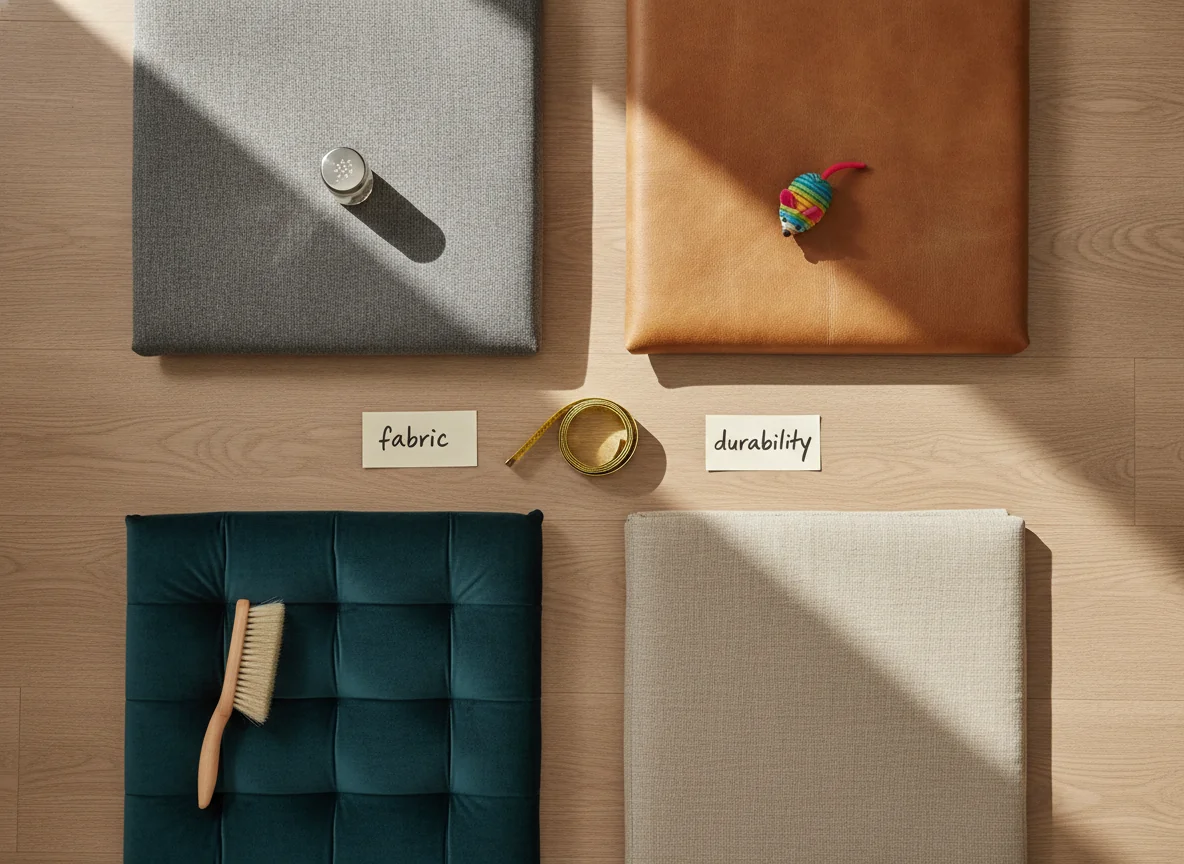
Adults-only household with no pets. This is the easiest fabric scenario because you can choose for feel and appearance without durability trade-offs. A linen-cotton blend offers breathability and a casual rumpled look. A wool or mohair velvet offers depth and durability without the “plastic” feel of synthetics. Cotton duck (the same fabric used for utility bags) is tough, inexpensive, and develops a pleasing worn patina over years.
Color and pattern. The single most practical fabric advice for any household: choose a sofa in a darker tone than you think you want. Cream sofas look beautiful in staged photos and show every crumb, every shadow, and every dog-nose smudge within three days. A medium gray, warm charcoal, deep navy, or olive-toned fabric hides daily wear and still photographs as a neutral that works with any decor. If you want a light look, layer light throw blankets and light pillows over a medium-toned sofa — the look is the same and the sofa stays presentable.
Previewing a sofa in your room before buying
The entire deck above — measuring, shape selection, seat depth, fabric — is intellectual work that you do before you’re confident about a sofa. But the intellectual work is incomplete without the visual work, and the visual work is what most shoppers skip. They measure the room, read the dimensions, decide the sofa sounds right, and order it. Then the sofa arrives and the scale is wrong in a way the dimensions didn’t convey.
Scale is not a number; scale is a relationship between the sofa and everything around it. A 90-inch sofa in a 14-by-20-foot living room with 10-foot ceilings reads differently than the same 90-inch sofa in a 12-by-16-foot living room with 8-foot ceilings. The dimensions are the same; the rooms are different. The only way to judge scale is to see the sofa in the room.
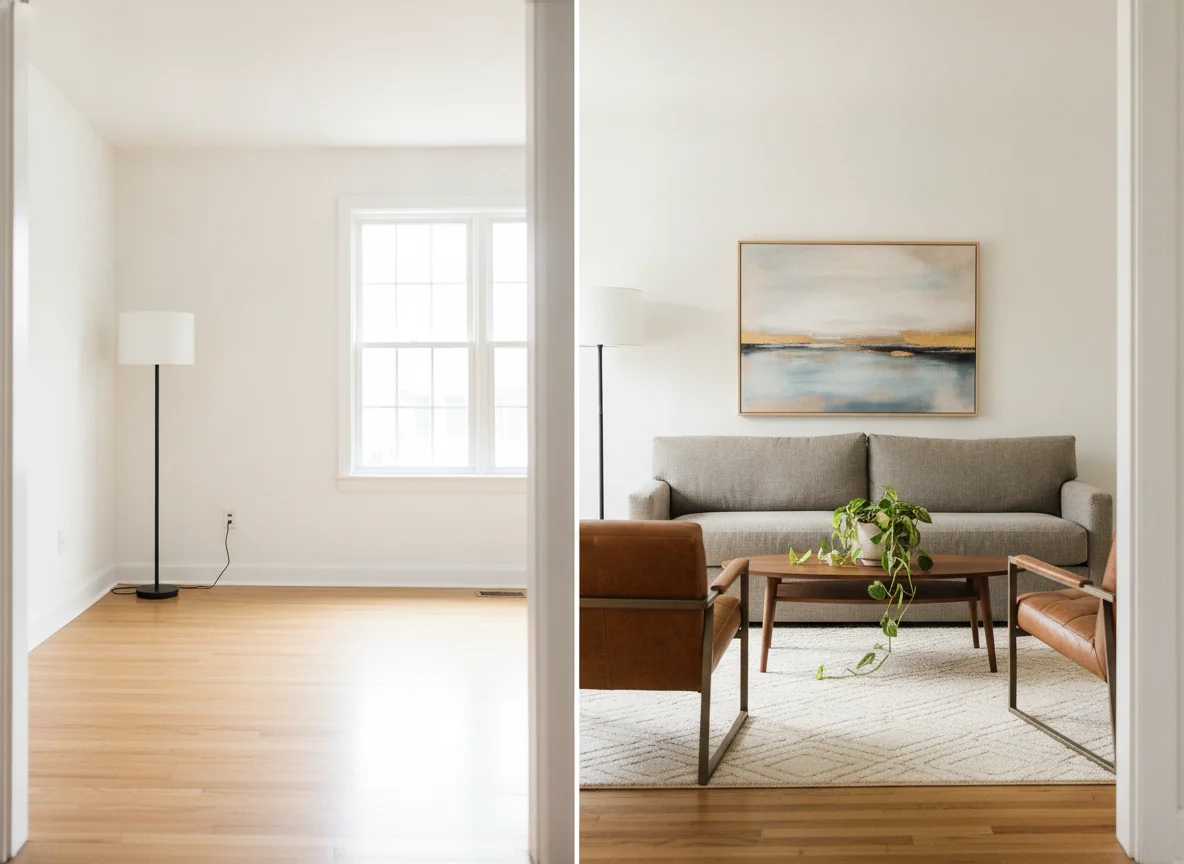
The AI preview workflow. Modern AI interior design tools — Roomagine included — can render a specific sofa in a photo of your actual room in about ten seconds. The workflow is simple: photograph the room from the room’s typical viewing angle (standing at the doorway or opposite wall), select or describe the sofa you’re considering, and the AI generates a rendered version of the room with the sofa in place, at the correct scale for the room’s dimensions.
What the render shows you:
- Whether the sofa width reads as proportional to the wall it sits against
- Whether the sofa depth leaves enough room in front for a coffee table and walking traffic
- Whether the sofa back height relates well to the window sill, the art above it, or the TV height
- Whether the sofa color works with the wall color, floor tone, and rug or coffee table you already own
- How the sofa relates to the other furniture in the room — does it dominate the accent chairs, or do they read as balanced?
You can generate three or four variants in an afternoon: the same sofa in two colors, or two different sofas from different manufacturers in the same render, or the same sofa at two orientations (centered vs. offset against the wall). The visual comparison answers questions that the dimension sheet never will.
The furniture-matching layer of Roomagine’s preview workflow also surfaces the actual product that corresponds to the rendered sofa — dimensions, fabric options, price, and a purchase link — so you don’t have to reverse-search the render to figure out what the AI showed. The rendered sofa is the sofa you can order.
toolset that extends beyond sofas to other furniture previews.](/blog/ai-interior-design/)
FAQ
What’s the first thing I should measure when buying a sofa?
The doorway — not the room. The most common sofa-purchase failure is not that the sofa doesn’t fit the room; it’s that the sofa doesn’t fit through the door into the room. Measure the front door width, every interior doorway on the path, and every hallway turn. If the sofa is longer than the doorway is wide, confirm the delivery team can tilt it through (most sofas tilt at 60 degrees) or choose a modular sofa that assembles inside.
How much room should I leave between the sofa and the coffee table?
14 to 18 inches from the sofa front edge to the coffee table edge is the standard range. That’s enough to reach a drink without leaning forward and enough clearance to walk past someone who’s sitting. For deep sofas (26-inch seat depth or more), push to 18 inches; the deeper seat means your knees are farther forward, and a closer coffee table hits your shins.
Should I buy a sofa that matches the wall or contrasts with it?
Neither extreme — aim for contrast that’s in the same tonal family. A charcoal sofa against a light gray wall works. A white sofa against a white wall makes the sofa read as a floating shape, disconnected from the room. A navy sofa against a beige wall provides clear visual separation. The AI render is the fastest test: render the same sofa in two or three color options against your actual wall color and see which one reads as integrated rather than imposed.
Is a sectional or a sofa-and-chairs arrangement better for a family?
It depends on how the family uses the room. Sectionals excel at lounging together — movie nights, casual weekends. Sofa-and-chairs excels at conversation — hosting, reading in separate spots, flexible seating that can be moved. For families with young children, a sectional is usually better because it keeps everyone oriented toward the same focal point (the TV, the play area, the fireplace) and provides more lounging surface for nap-time cuddles.
Can I use AI to preview a specific sofa I found online?
Yes. Roomagine’s preview workflow accepts a description of the sofa you’re considering — dimensions, shape, color, and style — and renders it at scale in a photo of your room. If the sofa is from a brand that Roomagine’s furniture database supports, the rendered piece is also a shoppable product; you can preview, confirm the fit, and click through to purchase. The preview takes about ten seconds per render.
What fabric lasts the longest on a daily-use sofa?
For daily use — three or more hours of sitting per day — the longest-lasting fabric in most price ranges is a tightly woven solution-dyed polyester in a mid-weight weave (300 to 500 grams per square meter). It resists fading, pilling, and staining better than any natural fiber, and it cleans with a damp cloth. In the premium range, Crypton or Sunbrella indoor-grade fabrics add a moisture barrier and a 10-year fade warranty. Avoid anything labeled “linen-look” or “cotton-linen blend” for daily use; they pill and stain within a year.
How do I measure seat depth if the listing doesn’t show it?
Check the product specifications tab — most major manufacturers list seat depth explicitly. If it’s missing, measure from the back of the frame (not the back cushion) to the front edge of the seat cushion. Some sofas have an angled back that effectively reduces the usable seat depth by two to three inches; if you see “seat depth: 24 inches” on a sofa with a heavily reclined back, the usable depth is closer to 21 inches. When in doubt, find the same sofa in a showroom and sit on it, or look for dimension verification in customer reviews.
See the sofa in your room before it ships
A sofa is the centerpiece of your living room — the piece every other furniture decision orbits around. Getting it right means measuring the room and the doorways, picking the shape that matches how you actually use the space, matching the seat depth to your height and sitting habits, and choosing a fabric that survives your household. Those are all decisions you can make on paper. The one decision you cannot make on paper is whether the sofa looks right in your room — and that’s the decision AI previews solve in seconds.
Roomagine is the AI room design app that lets you preview any sofa size, shape, and color in your actual living room before you order. Shoot a photo of the room from the doorway, tell Roomagine the sofa you’re considering, and a scaled photoreal render comes back in about ten seconds. See how the sofa width relates to the wall, how the seat depth works with the coffee table clearance, and how the color reads against your paint and flooring. The furniture-matching layer ties the render to a real, in-stock product, so you go from preview to purchase without the guesswork. The free tier covers your first few previews. Try it on the App Store or Google Play. See the sofa in your room before it ships — it’s the smartest decision you’ll make all year.